
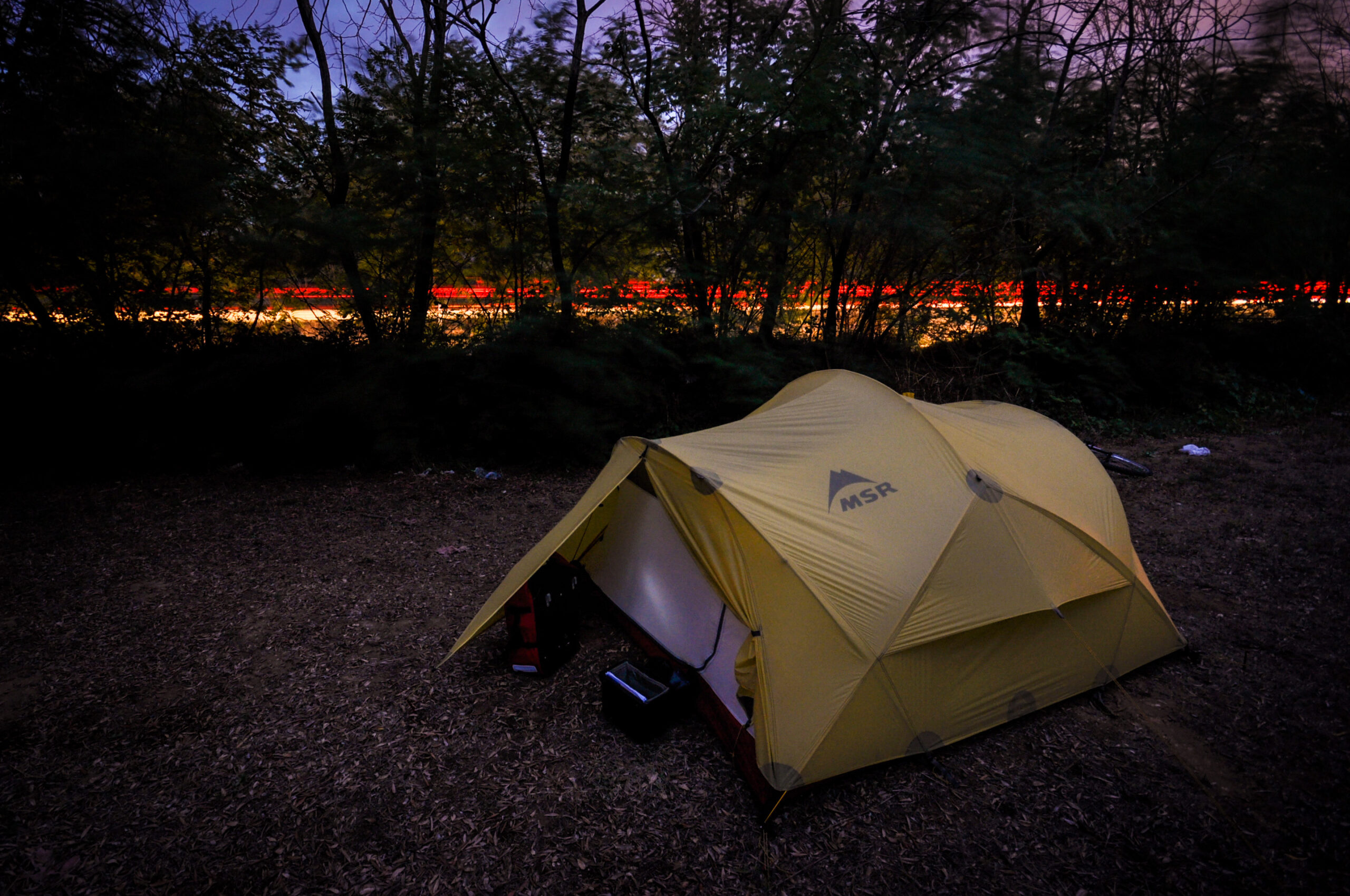
Wild camping (aka: stealth camping, free camping, or rough camping) is the practice of sleeping outside in a place of your choosing, rather than on an designated campsite or campground.
If you’re on a long journey, wild camping might be a necessity due to budget, the lack of other options, or for the love of sleeping outdoors. It’s not so much fun if you’re confronted and asked to move on in the middle of the night, and this is the biggest fear I hear from those new to the idea – but there are plenty of simple tips and tricks you can follow to minimise the chances of that happening, get a good night’s sleep, and hit the road feeling fresh and ready for the next day’s adventures. That’s what this post is all about.
As a long-distance cyclist (and hiker, hitch-hiker, paddler, and even horseback rider), I’ve been relying on wild camping for nearly twenty years. I’ve pitched my tent, hammock or bivvy bag in over a thousand unofficial camping spots on every continent except Antarctica. Trust me when I say I’ve made every mistake there is!
In this post, I’ll share my experience of what makes a good wild camping spot, practical advice for finding one, how to maximise your chances of spending the night undetected – and how to do all of the above in a responsible manner.

Incidentally, wild camping is a hot topic right now in my country of birth (England), because many lovers of the outdoors (myself included) believe that sleeping on land that was once owned by nobody is a birthright at best and a victimless crime at worst – but those who “own” that land often disagree, occasionally leading to court cases like this one.
Successful wild camping starts with the belief that doing so responsibility is probably okay. Armed with that conviction (no pun intended), you’re ready to take the first step towards finding an incredible wealth of free and inconspicuous places to rest your head. You’ll neither harm anyone nor disrupt their livelihood while doing so. And if you do it right, nobody will ever know you were there.

Why I Believe Wild Camping Is Possible Everywhere
My introduction to wild camping was back in 2007, when crossing Europe by bicycle on a shoestring budget (just over €5 a day) made sleeping stealthily outside a daily necessity.
Arriving in Istanbul at the end of that summer, I was amazed to calculate that during the four months it took me to cycle from England to Turkey, I’d spent a total of five nights in paid indoor accommodation – more than a hundred nights under the stars in a hundred different places.
Learning to rely on wild camping was difficult and stressful – at first. But soon, leadning that not only was it possible but relatively easy was a true revelation.
I was far from the first traveller to have had this realisation, and I thank the practice of wild camping for helping me cultivate a deeper connection with the world we live in – as well as allowing me to travel further, for longer, broaden my horizons, and become a better citizen.

How much money could wild-camping save you?
The initial drive to make wild-camping my primary form of overnight accommodation was financial. I had £3,500 in the bank and €800 in cash when I hit the road in 2007, intending to cycle round the world over a period of 3–4 years.
If I’d stayed at the cheapest available hostels in European towns and cities, at the time averaging about £10 a night, my first four months on the road would have cost an extra £1,200. That would have been about 25% of my entire trip budget.
Instead, I bought one good-quality tent costing £300. It had paid for itself within a month of cycling across Europe. (These days you can get a good tent for cycle touring or bikepacking for much cheaper than that.)
That’s not to mention that I was no longer restricted to travelling between places where accommodation was available. As a cyclist, I spent almost all of my time in the countryside between settlements – which is where all the best wild-camping opportunities were anyway.
Since that first trip, practice has made perfect, and there’s nowhere I’ve not successfully found a spot to sleep for free at night (except Myanmar).

My Top Tips For Successful Wild Camping
When talking about doing anything successfully, it’s a good idea to define what ‘success’ actually means.
For me, a successful wild camp is one which gives you a good night’s sleep, harms nobody in the process, leaves no trace, and ideally gives you the feeling of having won at life before breakfast.
It is poor wild-camping conduct that causes disruption and damage, creating a negative public image and fuelling arguments for laws and crackdowns against the practice.
It’s really important to remember that the vast majority of wild camping is motivated by practical considerations, rather than aesthetic ones.
So whatever ridiculous images people feel compelled to post on Instagram, know that the reality of wild camping is often mundane.

With realistic expectations in mind, here are some key strategies I’ve developed for finding a suitable place to wild camp, especially if you’re close to civilization and open country is in short supply.
These tips are written primarily with cycle tourers and bikepackers in mind, as that’s the focus of this blog – but they could just as well be applied if you’re on a thru-hike or backpacking trip – just as long as you’re carrying a suitable lightweight tent (or, if you think tents suck, one of the many tent alternatives for sleeping outdoors).
1. Talk to locals (if there are any)
If you’re unsure about the safety of your surroundings, or whether wild camping will be tolerated, stop and talk to whoever is around. 99% of the time, the people you meet will be very happy to help you find a suitable spot for your tent. Especially if you’re near a settlement, it’s always best to have the informed consent of nearby residents if available.
(This might seem to go against the very notion of ‘stealth’ camping. All I’ll say is that if you think the point of wild camping is to infiltrate a stranger’s backyard for the night and get away with it, you’ve got a long way to go.)
Often you’ll find that this will lead to social encounters and occasionally full-blown hospitality. This is one of the enviable experiences that few but the independent traveller have the opportunity to enjoy.
If there’s nobody around, of course – great! You hardly need permission if there’s no-one there to give it to you. Wild camping couldn’t be easier!

2. Know when to stop
If you’re in open country, allow at least 1–2 daylight hours to locate a suitable campsite. Allow even more time while you’re still learning what makes a good spot.
If you’re in or approaching a town or city, you will need to consider whether you need to stop for anything, and if you’ve got time to make it through and out the other side, or if you’re better off stopping sooner (or backtracking to that nice spot you just saw).
You’ll also need time to check the surrounding area before dark. Spending a few minutes absorbing the vibe is usually a good idea. If something feels wrong, trust your gut and move on. Your gut is usually right.
The amount of time you need will also depend on where you are. In truly wild places you may be spoilt for choice, but if you’re in a humanmade landscape, chances are you’ll need to keep moving for a while before you find the woodland/meadow/beach you’re looking for.
If you’re in a busy area with lots of people or traffic around, scout a spot, have dinner, then sneak off to your campsite after sunset. It’s not ideal, but you’re unlikely to be noticed after dark. Pitch your tent in the post-sunset twilight. Avoid using your headtorch and let your night vision develop instead. You’ll still be able to see enough, but drivers with their headlights on will perceive only darkness.

3. Get to know yourself better
Wondering why you’re anxious and paranoid on your first attempt at wild camping? Good news: this is exactly how you’re supposed to feel. (And it’s amplified if you’re doing it alone.)
Even with thousands of nights of wild camping experience, I still sometimes feel like this. Evolution favoured those who could identify potential threats and avoid them. Our survival in the past depended on having overactive imaginations, which were (and still are) great at creating wild fantasies of savage beasts and hostile tribes hiding behind every rock.
The simple truth is that you have to push through this phase of learning, and the easiest way to do this is to do more wild camping!
Once you’ve got over the hump, you’ll start seeing potential camping spots everywhere, and boring your friends by incessantly pointing them out.

Yes, there’s stuff living out there – mostly dogs and ants, in my experience (and, in England, fluffy little bunnies). And if a dog finds you in your nylon cocoon in the woods, it’ll leave you alone once it’s stolen your breakfast.
Almost no animal will come to you looking for a fight, because random aggression hasn’t generally been an evolutionarily stable strategy.
(If you’re American and you’re about to mention grizzly bears, you’re right. And you don’t need me to tell you how to camp safely in bear country.)
And humans don’t roam the fields and forests at night brandishing lethal weapons. Why? Because, like you, they’re afraid of humans roaming the fields and forests at night brandishing lethal weapons!
Once it gets dark, people are uninquisitive of anywhere outside the places they know by daylight. (The exception is border guards and other security forces, so don’t camp near them.)
Now, of course, we’ve slaughtered or contained most of the man-eating wildlife and have got used to living in each other’s company, so it’s usually safe to chill out. I’ve been hiding my tent just out of sight of roads all over six continents for months on end and have never encountered anything more than an invitation to come and sleep somewhere warmer and/or enjoy a glass or two of the local tipple (except for a black bear in Washington and some wild boar in the south of France).
Actually, you’ll be surprised where you can get away with putting a tent, sleeping rough or blagging a horizontal surface! Sometimes, in ’emergencies’, it’s been fun seeing what’s possible in this regard. I’ve slept in bus shelters, inner-city parks, building sites, roadside verges, subways, empty garages, petrol stations, fishing boats, tramps’ hovels, hotel gardens, under tables, drainage pipes, storage sheds, abandoned buildings – even about five metres from a busy main road in full view of anyone who cared to stop and take a look!

Sure, the last one wasn’t ideal – the mud was really sticky – but I still got my head down undisturbed for a few hours.
Of course, if you’re out in the Sahara or crossing the Mongolian steppe, you can put a tent anywhere you please. The world is your campsite. Enjoy it!
4. Practice the art of invisibility
Not being seen while wild camping is not just a practical concern – if you’re confident in your own inconspicuousness, you’ll also sleep much better. Luckily, there are a few simple things you can do to make yourself as invisible as possible.
The first is perhaps the most basic: get away from anywhere there are likely to be people. For cycle tourers, that means getting off the road and well away from the beams of passing headlights. For hikers, it means going off-trail. Avoid places that are obviously popular stops. A good rule of thumb is to keep moving away from the road or trail until the litter and used toilet paper stops, then go a bit further.
If you’re planning on sleeping in a tent, and you’re mostly travelling in temperate or tropical climates, try to get one in a natural shade of green. This will serve you well in a wide variety of environments, because if it’s green, stuff grows there, and if stuff grows there, people probably live there, and people can’t easily see a green tent in a green field or forest at night. (Other colours will get you by as well, just not as stealthily.)

Unstitch any shiny labels on the outside of you tent. Replace the guy lines for ones that aren’t luminous and ultra-reflective. Remember how useful you thought the reflective bits on your bags & tyres would be at night? Well, now they’re useful for showing passing drivers exactly where you are. Make sure they’re facing away from the road, or cover them with Gaffa Tape.
I often bring a dark-coloured poncho on longer trips, as a waterproof in heavy rain, a picnic blanket when it’s sunny, and finally a cover for my bike and gear to keep it dry and inconspicuous at night.

5. Consider alternative sleeping systems
I often travel with a bivvy bag or a hammock, as I explained in this post about why tents suck. These are, in fact, often more appropriate sleeping systems for wild campers than a tent.
For the uninitiated, a bivvy bag is British/American slang for a waterproof, breathable sack which offers an extra layer of protection for you, your sleeping bag, and your camping mattress. (Australians call the same thing a swag.)

Bivvy bags/sacks (or swags) are smaller and lower to the ground than a tent. As well as being almost invisible at a glance and in low light, many users prefer the feeling of sleeping outdoors in a bivvy bag than that of being cooped up ‘indoors’ in a tent.
For added protection from the elements, learn to rig up a green or camoflague-pattern poncho or tarp as a shelter (or a ‘basha’ in military-speak) using a bit of light paracord and/or a few cargo bungees such as the ones that might be strapping stuff to your bike. Slide under this in your bivvy bag and you’ll stay dry even in a downpour. (For the full military experience, leave your boots on inside your sleeping bag as well.)

Another approach is to use an inconspicuous camping hammock, such as the Hennessy (which I absolutely love).
The great benefits of a hammock in the context of wild camping is that they will allow you to sleep outside in denser, lumpier woodland and on steep wooded hillsides, neither of which are suited to ground-based camping.

In summary: Relax!
My distilled advice for successful wild camping? Prepare as well as you can, believe that there’s a perfect spot just waiting to be discovered, and leave it just as you found it.
Once you’ve got the hang of it – and it will take a few attempts – you’ve got a dependable tool for getting a good night’s sleep anywhere in the world, for free.
Just imagine the possibilities…!
Perhaps you’re an experienced wild-camper already? Why not share your top tips with us in the comments below?

Bogged down in research for your next big bicycle adventure?
I wrote a whole book to help with that. How To Hit The Road is designed to be read at your leisure, making planning a bike tour simple and achievable, no matter the length, duration or budget. Available globally as an ebook or paperback.


Something to add?